DEAL
Take your hand of instruction cards. Damage reduces your choices.
Programmed movement · 2–8 units · Rally / Deathmatch
Belts move. Rams fire. Turntables turn. Crushers descend. The schedule does not care what you intended to do next.
Plant 7 was decommissioned in 2049.
The machinery still operates on schedule. The payroll system still recognizes completion. The Clankers are still trying to clock in at every station on their route.
You do not steer a Clanker continuously. You write five instructions, commit them, and watch the factory explain why your plan was wrong.
Take your hand of instruction cards. Damage reduces your choices.
Load five cards into slots 1–5. This is the whole plan.
Lock it in. Once execution begins, there is no changing it.
Everyone runs slot 1, then slot 2, through slot 5. Lower priority numbers act first.
After every slot, the factory moves and fires. Then clocks stamp. At clock-out, repairs and reboots resolve.
Punch the numbered Punch Clocks in order. Only the clock you need next is lit for you. You punch it by being on the checkpoint when the slot ends, after the plant has finished acting.
A Rally reaching the 300-shift limit without a finish is a draw.
No clocks. The last player with a unit left wins. Shoving a unit into an immovable barrier deals a Dent, the host chooses 1–8 chassis per player, and scrapped units return at the quietest start.
At the shift limit, best condition wins; exact ties are shared.
The deck is shared, reshuffled every shift, and every card has a unique priority from 10 to 1120. Lower resolves first.
Move one tile left or right relative to your facing. Facing does not change.
Do nothing. Because it resolves late, it also makes you an excellent target for everybody else.
Moves, slides and your inspection laser are all relative to where your Clanker is pointing.
Move into an occupied tile and you shove that unit one tile in your direction. Shoves chain. A wall anywhere in the chain stops everybody.
Being shoved never turns you. Your remaining program continues from the new position, still facing the old way.
Every unit fires forward automatically once per step, after movement is finished. One Dent to the first unit hit.
A tile is one square of floor. Every machine below occupies or controls one. Nothing on the factory floor is random: the machinery tells you what it is going to do. Whether you notice is a separate matter.
Starting at 5 Dents, registers jam from slot 5 downward. A jammed slot keeps the card already in it across shifts. At 9 Dents, all five are jammed and you are dealt no cards.
At 10 Dents the chassis is scrapped for the rest of the shift. At clock-out, a replacement returns with zero Dents.
Book a Rest and you skip the entire shift: no program, no shooting and no checkpoints. One Dent repairs at the start of each slot, up to five.
REST IS NOT A SHIELD. You may still be shoved, carried and shot while repairs are happening.
The host chooses the number of units up to the route's available Starting Points. Empty seats are filled by AI immediately.
Your seat belongs to you. If you disconnect, AI keeps the unit moving; return and you resume at the next programming phase.
After the first shift is dealt, new arrivals go to the bench. The host can hand them an AI-driven unit.
The personalities are the difficulty curve. They differ in what they want and how hard they search for it.
Knows the hazards, knows a safe route exists, and generally takes it.
Commits hard to plans that were reasonable when programmed and catastrophic by execution.
Prices danger, then takes the line anyway when the shortcut is worth it.
Knows the path and largely refuses to respect the hazards on it.
Balances healing and dangerous routes with far more confidence than is healthy.
A battlebot that wandered into a Rally. Scrapping another unit may matter more than the clocks.
Opportunistic and aware of the whole floor. It can read programs already committed by other players.
A hunter crossed with the Supercomputer. It wants to scrap you, and it can see your committed program.
Controls are bindable. This manual names the action you want rather than pretending everybody's A button means the same thing.
This spread now uses the extracted prototype UI directly. Think of the screen as four jobs running at once: follow the floor, track the shift, watch the roster, and program your unit without panicking.
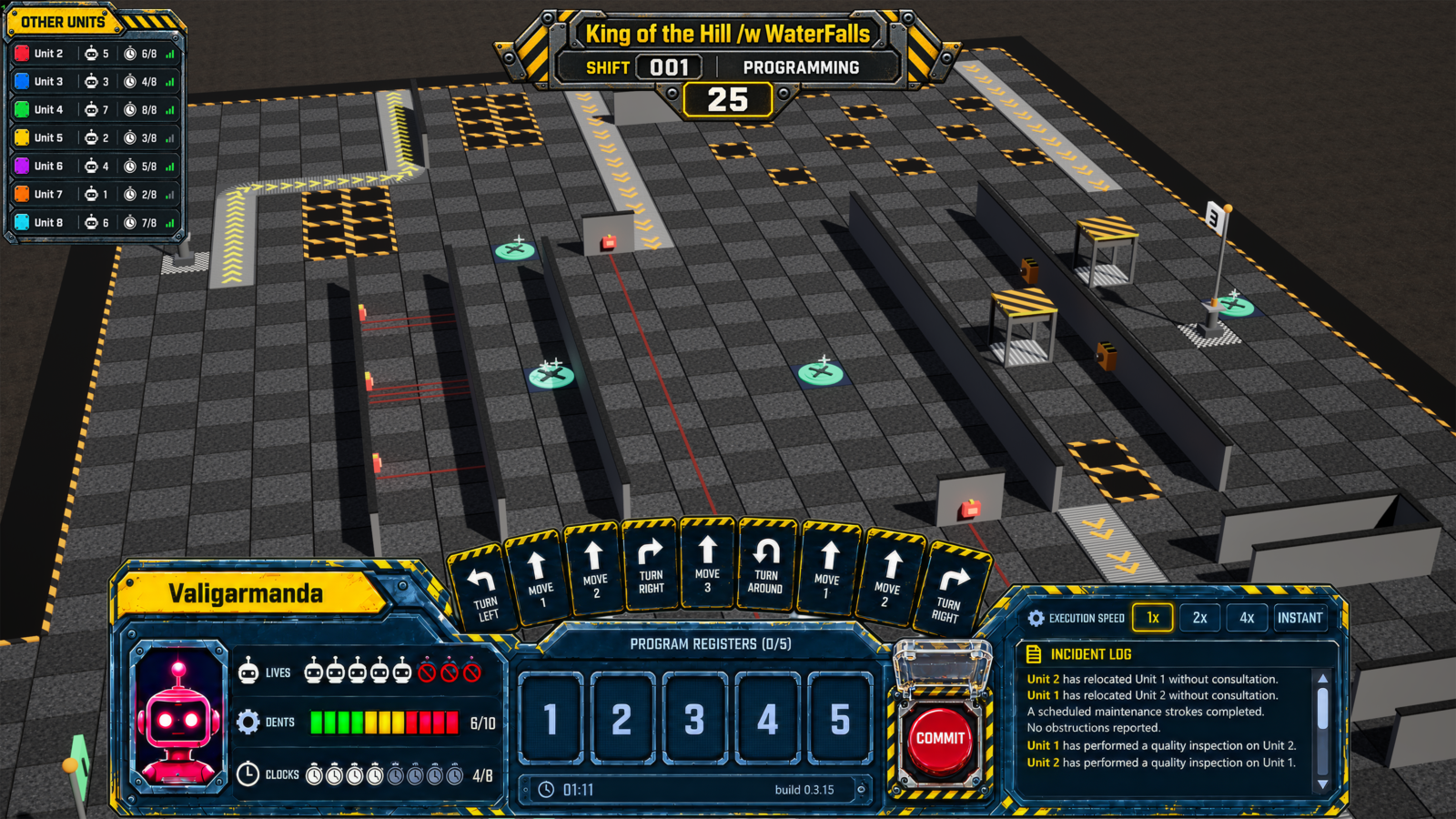
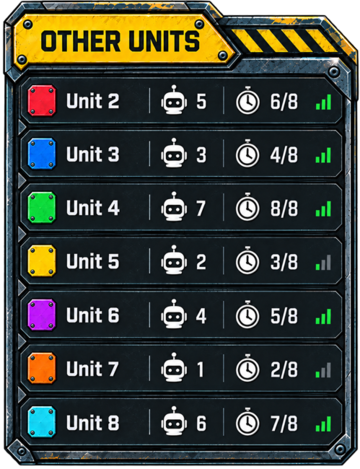
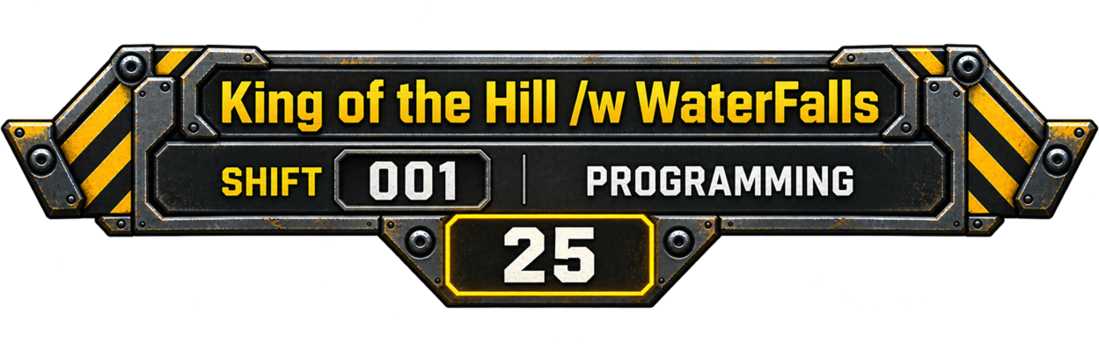
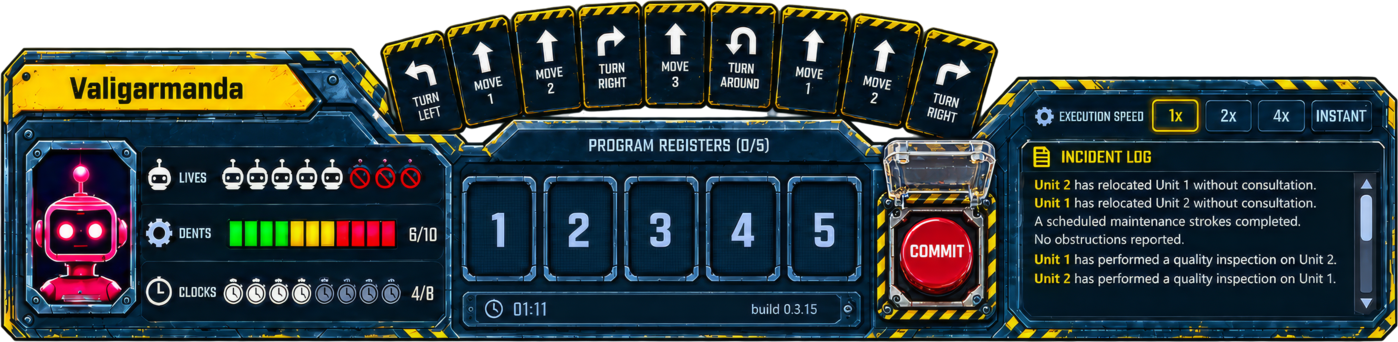
Your pilot plate holds the portrait, Lives, Dent track, and punched Clocks. This is your condition report.
The drawn action cards arc across the top edge so you can read the whole hand before filling registers.
Five large slots keep the sequence obvious. Empty slots are unmistakable, and filled slots read left to right.
The flip-cover red button is perfect for the manual. It makes locking in your program feel deliberate and dangerous.
Replay and simulation pacing live above the log so spectators and players can speed up or slow down the chaos.
The log is your witness statement. If something unexpected happened, this is where players check the sequence.
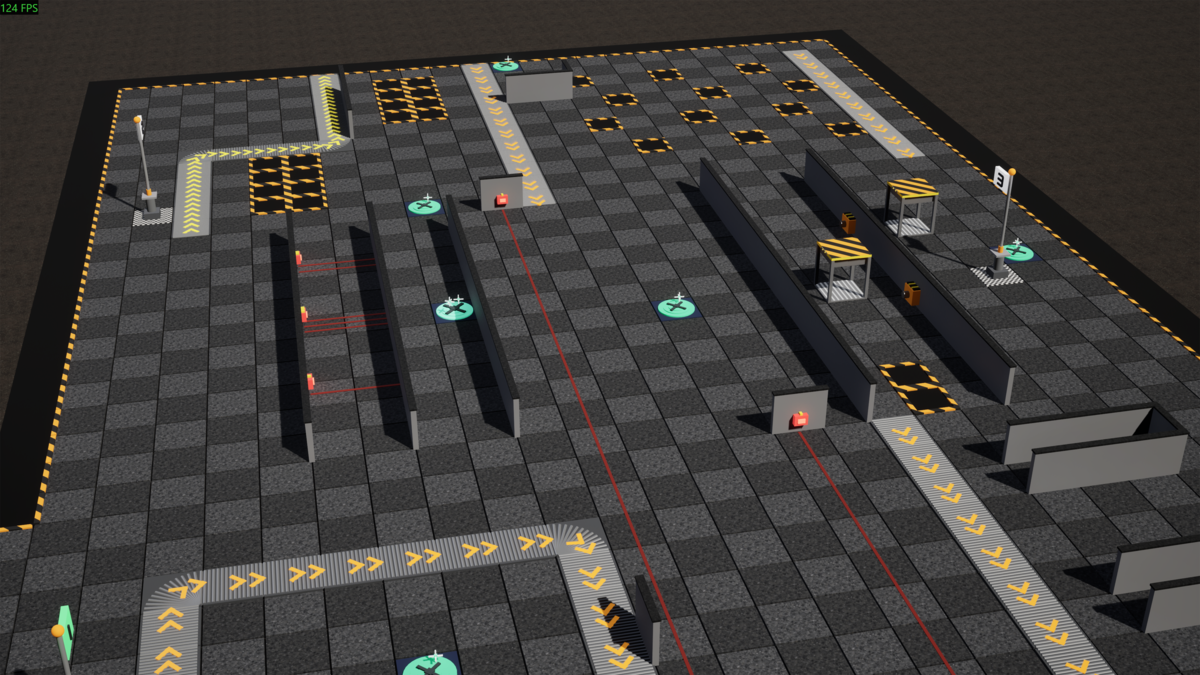
The HUD frames the board rather than covering it. Belts, hazards, walls, lasers, objectives, teleporter pads, and unit positions remain readable so the player can plan around the real factory state instead of a simplified abstract diagram.
The Route Builder works at tile level: place the piece, rotate it, configure its properties, change storeys, save, open and test the actual 3D floor.
Tile means one playable square. Route means the complete floor. The builder can use stamps/sections as authoring aids, but the player ultimately plays one continuous route.
Local routes are yours. Workshop routes are Steam-managed subscriptions. Stock routes ship with the game. Opening a Workshop or Stock route for editing creates your own working copy rather than changing the source.

Drop a temporary unit onto the floor to test laser blocking, crushers, lifts and other machinery. It is not saved into the route and never appears as a gameplay tile.
The easiest way to understand the Plant is to stop looking for chain reactions. Your card runs first. When the slot ends, the Plant reacts. If that reaction puts you onto another machine, the new machine waits for the end of the next slot.
 →
→
The belt carries you onto the Teleporter at the end of this slot. You stay there. The Teleporter cycles you at the end of the next slot.
 →
→The Ram shoves you onto the Teleporter. Same rule: no second Plant action this slot. The Teleporter waits until the next slot ends.
→
The belt can leave you standing on a Turntable, but it does not spin you immediately. The Turntable acts at the end of the next slot.
 →
→
A Pressure Plate is evaluated at the end of the slot. Its Gate change is therefore something you plan around for the next slot, not the movement that just finished.
CARD → PLANT → CARD → PLANT
The Plant never gets two turns because its first turn moved you somewhere interesting.Deal → load five → commit → slots 1–5 → clock-out.
LOWER NUMBER RESOLVES FIRST.
Punch numbered clocks in order. Only the next valid clock counts.
No clocks. Last player with a unit left wins.
First two Dents are free. Jams begin at 5. All slots jam at 9. Scrap at 10.
Skip the shift. Repair 1 Dent at the start of each slot, max 5.
Plant movement does not cascade. If a Plant action moves you onto another machine, that machine waits for the next slot.